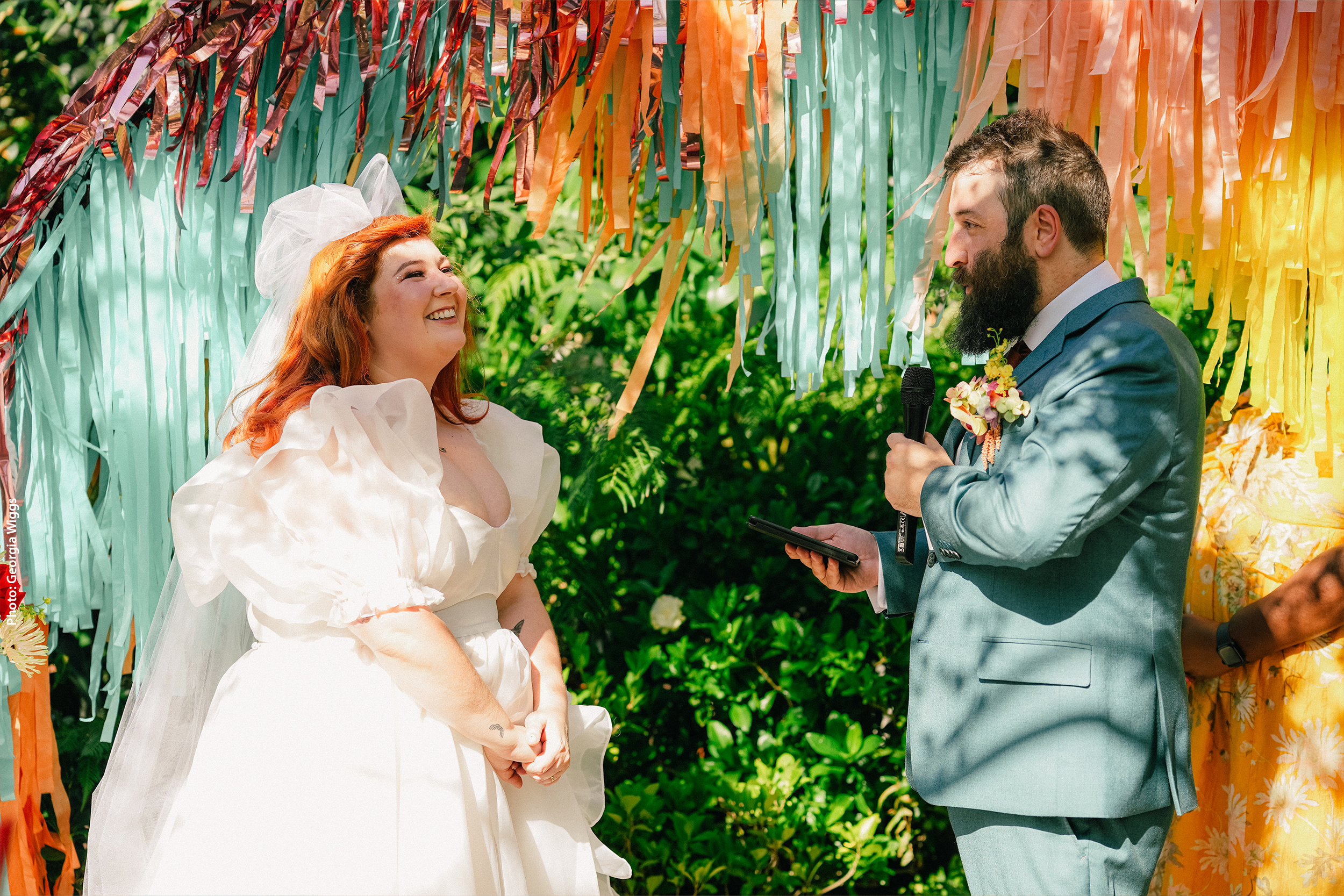
Wedding readings have been part of Polka Dot Wedding for years now. A passage read by a parent, a poem picked by a friend, a few lines from a book you adore. The words spoken during a ceremony can be a very important part of the day, and yet most couples get to “choose your readings” on the planning list and get completely stuck.
So, here is the black-and-white guide. What readings actually are, how to choose one, who should read it, and where to find the words themselves.
What a wedding reading actually is
A reading is simply a moment in the ceremony where someone else’s words are chosen to say something you want said. A poem, a book passage, song lyrics, a quote, or something written just for you. There are no rules about what qualifies.
Most readings run one to two minutes, which is shorter than people expect. Roughly half a page. A reading that goes past three minutes starts to lose the room, no matter how beautiful it is.
Where they sit is up to you and your celebrant. Most commonly, a reading is placed either early in the ceremony, to settle everyone in, or just before the vows, to set them up. One reading is the most common choice. Two works. None is also completely fine. Plenty of beautiful ceremonies skip them entirely, and if that is you, there is a strong case for keeping the whole thing simple.
How to choose a wedding reading
The only real test is whether it sounds like you. Not the fanciest thing you can find, and not the one everyone uses. The one that makes you both go “yes, that.”
A few things that help:
- Read it out loud before you commit to it. Plenty of readings look lovely on the page and turn to porridge when spoken. If you stuwhile mble reading it to each other on the couch, it will stumble on the day.
- It doesn’t have to be about love. Some of the best readings are about friendship, or home, or luck, or growing old. If it says something true about the two of you, it belongs. This is also where you can bring in who you are and where you come from, and there is a lovely piece on elevating your words and building inclusivity into a ceremony by wedding celebrant Dee Wild, if you want to think about that more deeply.
- You are allowed to edit. Trim a poem, cut a paragraph, use only the good bit. Tarere is no readings police.
- It is worth starting with your story rather than with Google. The right words usually come from working out what you are actually trying to say first, then finding something that says it.
Celebrant Josh Withers has shared his own tips on picking ceremony readings, and they are well worth a read. He has married hundreds of couples, so his advice comes from watching what actually works for couples in real life.
Who reads it, and how to ask them
This choice matters as much as the words themselves. A reading delivered by the right person becomes a special moment in your ceremony. The same reading mumbled nervously by someone who hates public speaking becomes a long ninety seconds for everyone.
You want someone comfortable speaking in front of a crowd, or at least someone who won’t be undone by it. It is also a lovely way to include someone who isn’t in the wedding party, like a grandparent, a sibling, or the friend who introduced you.
When you ask them, give them the actual reading then and there, rather than “we’ll send it closer to the day.” They need time to sit with it, practise it, and stop being terrified of it. And if you have chosen a crier, and you know who they are, have a quiet backup plan. Sometimes the celebrant ste;s in, sometimes the tears are the moment. Both are fine.
It is worth thinking about access here too, both for the person reading and for the guests listening. Celebrant Diana Fisk’s gto uide creating an accessible and inclusive ceremony is a good place to start.
A parent reading carries a different wethanht to a friend reading. A parent is speaking about a relationship they have watched from the very beginning, so it is worth matching the reading to the reader. We have gathered collections for both: Readings for Parents to Read and Readings for Friends to Read.
Where to find the words
This is the part we have spent years building. The Wedding Readings Edit is the home for all of it, with readings sorted by who is delivering them and where they come from.
A few places to start, depending on where you are at.
Try Readings from Books and Literature if you want something with a bit of history behind it, or Wedding Readings from the Bible if tradition matters to you or your families. There is Wedding Readings for Older Couples if you are marrying with more life behind you, because love in later life often has a different kind of story. And Wedding Readings from Real Couples will show you what people actually chose, which is often the fastest way to work out what you want.
Your celebrant makes the difference
A good celebrant knows how to weave a reading your ceremony, so it makes sense. They know where it should sit, how to introduce it so it doesn’t arrive cold, and how to fold it into the rhythm of the whole ceremony. There is a real argument that choosing your celebrant is the most important decision of the wedding, and readings are one of the places you feel it.
Our Celebrant Directory is a list of Australian and New Zealand celebrants we actually trust. Filter by location and find someone who gets it.
A note from us
A reading is one of the few moments in the whole day where someone else’s voice takes over. Choose words that sound like you, give them to someone who will do them justice, and give that person the time to get comfortable. That is the entire trick. And if you want the reading to sit inside a ceremony that feels considered from start to finish, our guide to creating an intentional wedding ceremony is the natural next step.


Join the conversation